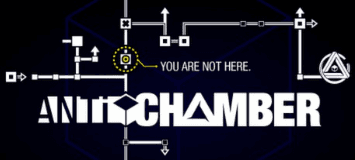
Antichamber builds its corridors from non-Euclidean geometry where turning around produces a different space than the one just left. Twenty-five awards preceded its 2013 release. GPA scores it at the top for Puzzle among first-person exploration games — the spatial logic is the game design.
Game Characteristics
Puzzle
90%
Existential Themes
75%
Dystopian Setting
65%
Graphics
50%
Player profile fit
Recommended for: Intermediate to Advanced players (A score of 50 or higher indicates a good fit.)
Beginner
35
Intermediate
60 ✓
Advanced
75 ✓
Keywords
非ユークリッド空間エッシャー的構造25以上の受賞歴物質操作ガン不条理建築の先駆者
Gameplay Profile Chart
Adjust tag ratios to instantly update similar titles in real time.
Puzzle
90%
Existential Themes
75%
Dystopian Setting
65%
Graphics
50%
Top 8 Tags — Radar Chart
CurrentOriginal
Games Similar to Antichamber (474)
GPA match scores are calculated from gameplay profile tags. They are not editorial “feels like this game” ratings.
Animal Well is a single-developer Metroidvania built on a custom engine over four years, placing a featureless blob creature inside an underground labyrinth full of animals and layered secrets. The community discovery element — secrets that took months to find — is a designed feature. Switch, PS5, PC, Xbox Series X|S. GPA scores it at the top for Puzzle — the Metroidvania where the entire community is the intended player.
Metroid Prime Remastered rebuilds the 2002 GameCube original with fully updated visuals while preserving every room layout, scan point, and environmental detail. First-person exploration on Tallon IV remains the standard for atmosphere-through-design. Switch exclusive, February 2023. GPA scores it high on Action and Existential Themes — the 3D Metroidvania benchmark that proved the genre works in first person.
The Turing Test sends ISA engineer Ava Turing through a research station on Europa, solving rooms designed by an AI called TOM that cannot solve them itself — the practical implication of the Turing Test as a game mechanic. Bulkhead Interactive, Square Enix Collective. Switch, PS4, Xbox, PC. GPA scores it high on Existential Themes and Puzzle — the puzzle game where the mechanic and the philosophical question are the same thing.
Axiom Verge 2 takes place on a parallel world with a different protagonist, adding a drone that can explore areas Indra cannot reach. Thomas Happ's solo development continued for the sequel, resulting in a more mysterious and less combat-forward experience than the first. Switch, PS4, PC. GPA scores it high on Puzzle — the Metroidvania sequel that shifted from action to exploration as its primary axis.
Thomas Happ built Axiom Verge alone over five years as a tribute to Super Metroid, adding a hacking mechanic that reprograms enemies and environments. The 2015 result matched the precision of the original it referenced. Switch, PS4, PC. GPA scores it high on Action and Puzzle — the Metroidvania built by one person that earned comparison to its inspirations on pure design merit.
Super Metroid built the exploration design template that defines the Metroidvania genre — a seamless alien world, ability-gated progression, and a lone bounty hunter against a hostile planet. The 1994 SNES release remains the benchmark for environmental storytelling through layout. Available through Nintendo Classics. GPA scores it at the top for Action and Puzzle among the genre's founding entries.
Jusant asks only one thing: climb. A dried-up world's monolithic tower offers handholds, rope anchors, and a small companion creature, with no combat and no dialogue — only the rhythm of ascent. DON'T NOD. PS5, Xbox Series X|S, PC. GPA scores it high on Existential Themes and Graphics — the climbing game that made verticality and atmosphere the entire design brief.
The Talos Principle 2 expands the first game's philosophical puzzle structure across an open-world post-human civilization, where a robot society debates consciousness, freedom, and what it means to continue humanity's work. The laser and jammer puzzle design scales to twelve times the first game's scope. Croteam and Devolver Digital. PS5, Xbox Series X|S, PC. GPA scores it at the top for Puzzle and Existential Themes — the game where the philosophical dialogue and the puzzle design share equal weight.
I'm on Observation Duty tasks players with monitoring security camera feeds across a house and flagging anomalies before a time limit expires. The series extends to eight entries. GPA scores it high on Horror and Puzzle — the anomaly detection mechanic applied to static surveillance footage rather than first-person traversal.
Limbo renders a boy's journey through a monochrome nightmare in silhouette, using physics puzzles and environmental hazards to tell a story without a single word. Playdead's debut. Switch, PS3/4, Xbox, PC. GPA scores it high on Existential Themes and Puzzle — the wordless puzzle platformer that Inside later built upon, establishing Playdead's visual storytelling identity.
Scorn drops players into a world of biomechanical architecture drawn directly from H.R. Giger and Zdzisław Beksiński without explanation or dialogue. The environment is the horror. Puzzles use organs and living machinery. Ebb Software's debut. GPA scores it high on Dark World and Existential Themes — the art-horror game where the visual language is the entire experience.
Visage explores a house with multiple dark histories through its past residents' chapters, with a sanity system that breaks down when players stay in darkness or witness disturbing events. The P.T.-inspired design delivers the full playable horror experience that Silent Hills never completed. GPA scores it high on Horror and Existential Themes — the most complete realization of the atmospheric haunted house genre.
Majora's Mask gives Link three days before the Moon falls, then resets everything when time runs out. Fifty mask sidequests run across the three-day cycle, each requiring careful timing to complete. Available through Nintendo Classics. GPA scores it high on Existential Themes and Puzzle — the Zelda entry with the darkest atmosphere and the most emotionally complex sidequests.
Observation inverts the sci-fi thriller premise by casting the player as SAM, the space station's AI, rather than the human crew member. Using cameras, drones, and station systems to investigate the disappeared crew creates a perspective no other game occupies. No Code, Devolver Digital. PS4, Xbox, PC. GPA scores it high on Existential Themes and Puzzle — the SF thriller where being the AI is both the mechanic and the message.
Portal introduced the Aperture Science Handheld Portal Device and GLaDOS in a 2-hour puzzle experience included in The Orange Box. The spatial reasoning puzzles and the AI antagonist's dry humor generated one of gaming's most quoted lines. Valve. Switch, PS3, Xbox 360, PC. GPA scores it at the top for Puzzle — the game that proved a single mechanic executed perfectly outweighs any feature list.
Backrooms: The Project starts in empty corporate offices before descending through level structures rendered in UE5. The photorealistic fluorescent corridors are the highest production value entry in the Backrooms genre. GPA scores it high on Horror and Graphics.
Confabulation photographs changes in a home where the player's memory of the layout is unreliable. The camera serves as both tool and metaphor for the game's central theme. GPA scores it high on Horror and Puzzle — the memory-photograph mechanic sits between Exit 8's anomaly logic and Observation Duty's surveillance framing.
Amnesia introduced the sanity meter — look at monsters and the player's vision deteriorates and strange sounds intrude. There are no weapons. The castle setting and helplessness design drove the early YouTube Let's Play phenomenon. Frictional Games' 2010 release established the template for first-person horror games for the following decade. GPA scores it high on Horror — the game that rewrote horror design conventions.
Blasphemous builds its Metroidvania around Catholic iconography from Andalusia — self-flagellation, penitence, and martyrdom rendered as both enemy design and narrative structure. The Penitent One's pixel art and the brutal parry-timing combat made it a standout. Switch, PS4, Xbox, PC. GPA scores it high on Dark World and Action — the Metroidvania with the most distinctive thematic identity in the genre.
Serene Asylum wakes players on a surgical table in an asylum with a history that surfaces through documents. The infinite loop structure traps the space in repetition. GPA scores it high on Horror and Puzzle — a free-to-play horror that applies the loop mechanic to institutional architecture.
Antichamber(アンティチャンバー) leads with its 非ユークリッド探索パズル identity, anchored by the core feel of "Antichamber builds its corridors from non-Euclidean geometry where turning around produces a different space than the …." The headline profile reads Puzzle 90% / Existential Themes 75% / Dystopian Setting 65%, making it a strong pick for fans of Puzzle and Existential Themes. Oriented toward experienced players looking to push their limits.
▸Characteristics & Analysis
Our editorial team scored "Antichamber(アンティチャンバー)" by using its feel of 非ユークリッド空間, エッシャー的構造, and 25以上の受賞歴 as the primary lens, weighting Puzzle and Existential Themes most heavily. Top similar titles include "アニマルウェル(Animal Well)", "メトロイド プライム リマスター(Metroid Prime Remastered)", "チューリングテスト(The Turing Test)".
Review — Antichamber: A Puzzle Game Where Questioning the Rules Is the Key
Overview
Antichamber is a first-person exploration puzzle game developed by Alexander Bruce and released on January 31, 2013.
The game takes place in a strange world where conventional rules of space do not apply. A hallway may lead somewhere completely different depending on how you approach it. A path that looks blocked from one direction may suddenly become accessible from another. And returning to a place you have already visited does not necessarily mean you will find the same space waiting for you. Inspired by the impossible architecture of M.C. Escher, Antichamber turns a non-Euclidean world into a giant puzzle.
Steam describes the game as an experience where nothing can be taken for granted, with hallways wrapping around one another and spaces reconfiguring themselves as the player explores. (Steam Store)
As the game progresses, the player also gains access to a special gun capable of creating, destroying, and manipulating matter. It is not primarily a weapon. It is a tool for changing the environment and finding new ways through the world.
Gameplay Analysis
The Real Puzzle Is Your Way of Thinking
The defining feature of Antichamber is that it doesn't simply ask you to solve puzzles. It asks you to question the assumptions you are using to solve them. In a conventional puzzle game, the rules are usually stable. Press a switch. The door opens. Move into the next room. The challenge is finding the correct solution within those established rules.
Antichamber constantly undermines that expectation. A wall that looks impassable may not actually be impassable. A dead end may not really be a dead end. A path that seems to require turning around may have another solution entirely. The key skill is therefore not just puzzle-solving ability. It is the ability to recognize when your own assumptions are the problem.
Steam describes the game as a psychological experience built around questioning how games work, with challenges specifically designed to subvert the player's expectations. (Steam Store)
When Non-Euclidean Space Becomes the Puzzle
Antichamber's strange spatial design is more than visual spectacle. The architecture itself is the puzzle. In an ordinary 3D game, moving forward means moving forward. Rooms have consistent relationships with one another. A place you have already visited remains the same place. Antichamber doesn't necessarily follow those rules.
The meaning of a space can change depending on where you approach it from, forcing the player to rethink how the world is connected. The result feels like walking through an Escher painting rather than simply looking at one. The player isn't solving a puzzle inside a strange world. The player is solving the strange world itself.
A Gun That Changes How You Explore
Later in the game, the player gains a special gun that can manipulate matter. It can create, destroy, and move objects, turning the environment into something that can be actively reshaped. That means progression isn't simply about learning new information. It is also about gaining new ways to interact with the world.
A previously impossible route may suddenly become possible. A seemingly useless object may become part of a solution. And a puzzle that appeared to have no answer can become straightforward once the player understands how the tool interacts with the environment. The official Steam description specifically highlights the gun's ability to create, destroy, and manipulate matter. (Steam Store)
Antichamber Through GPA
Title tendency chart (Antichamber)
Puzzle ◀
90%
Existential Themes ◀
75%
Decadent Worldview
65%
Graphics
50%
* Based on GPA sub-tag scores. Audience: Beginners 35% / Intermediate 60% / Advanced 75%
Puzzle: 90%
Antichamber's highest GPA score is Puzzle at 90%. This does not simply mean that the game contains difficult puzzles. Its real strength is that it repeatedly forces the player to change how they think. If a path is blocked, don't automatically assume it is impossible. If you reach a dead end, don't assume turning around is the answer. If the environment appears to follow a certain rule, consider whether that rule is actually reliable. The game rewards flexible thinking more than memorizing information.
Existential Themes: 75%
Antichamber scores 75% for Existential Themes. That does not come from a conventional philosophical narrative. Instead, the theme emerges from the way the game challenges the player's perception of reality. In most games, players naturally assume that walls are solid, hallways connect in predictable ways, and a place remains the same after you leave it. Antichamber breaks those assumptions — and the puzzle-solving process becomes an exercise in questioning your own perception.
Decadent Worldview: 65%
Antichamber scores 65% for Decadent Worldview. The game isn't about ruined cities or a collapsing civilization. Its atmosphere comes from something more abstract: an artificial world that feels completely detached from ordinary human life. Sterile corridors, geometric structures, colored rooms, and enormous empty spaces. The world feels less like a place built for people and more like an elaborate experiment. Its 50% Graphics score also reflects an important distinction: Antichamber isn't trying to impress through photorealism. Its simple shapes and colors allow the player to focus on the architecture itself — and on the strange ways that architecture behaves.
Is Antichamber Too Difficult for Beginners?
GPA rates the game at 35% for beginners, 60% for intermediate players, and 75% for advanced players. The difficulty isn't primarily about complicated controls. The real challenge is learning to abandon familiar assumptions. Antichamber deliberately uses those expectations against you — which is why even experienced puzzle players can get stuck. But when the underlying rule finally clicks, the reward is substantial. A room that previously seemed impossible suddenly makes sense.
Who Should Play Antichamber?
Love puzzle games
Enjoy first-person puzzles such as Portal
Want unusual game mechanics
Like Escher-style impossible architecture
Enjoy discovering rules rather than being told them
Prefer experimentation to following a linear path
Want challenging puzzles
Enjoy games such as The Witness or Manifold Garden
Players who prioritize character-driven storytelling or clear objectives may find the experience frustrating. Also try Portal 2 and Manifold Garden.
Final Thoughts
Antichamber is a puzzle game, but it is also a game about breaking the player's assumptions about how games are supposed to work. Puzzle: 90%. Existential Themes: 75%. Decadent Worldview: 65%. Graphics: 50%. Those numbers reveal where the game's strengths really lie — not in visual realism or a cinematic story, but in changing the way you think and suddenly seeing a path that wasn't visible before.
Instead of trying to break the wall in front of you, ask whether it is really a wall. Instead of immediately turning around at a dead end, ask whether there is another way through. And when the world seems to follow a rule, ask whether that rule can actually be trusted. Released in 2013, Antichamber remains an important example of how an indie puzzle game can turn the basic assumptions of game design into the puzzle itself.
The key to Antichamber isn't knowing the right answer. It's being willing to question what you thought was true.