Gameplay Analysis
Stylish Combat Is the Way In
The first thing that makes NieR:Automata enjoyable is how good the combat feels.
You can combine light and heavy attacks, dodge incoming attacks, switch between weapon sets, and use your Pod to attack enemies from a distance.
The controls are relatively accessible, but there is plenty of room to improve your timing and develop your own approach to combat.
Dodging at the right moment creates a brief period of invulnerability and can lead directly into a counterattack. The game also seamlessly shifts between different camera perspectives, including side-scrolling and top-down sections, without completely changing the basic controls.
That smooth action gives the player an immediately enjoyable reason to keep moving forward.
And it becomes the entry point for a much heavier story.
Seeing the Same World From Different Perspectives
One of NieR:Automata's most important features is that the story doesn't simply end after one playthrough.
As you continue, the same world is presented from different characters' perspectives.
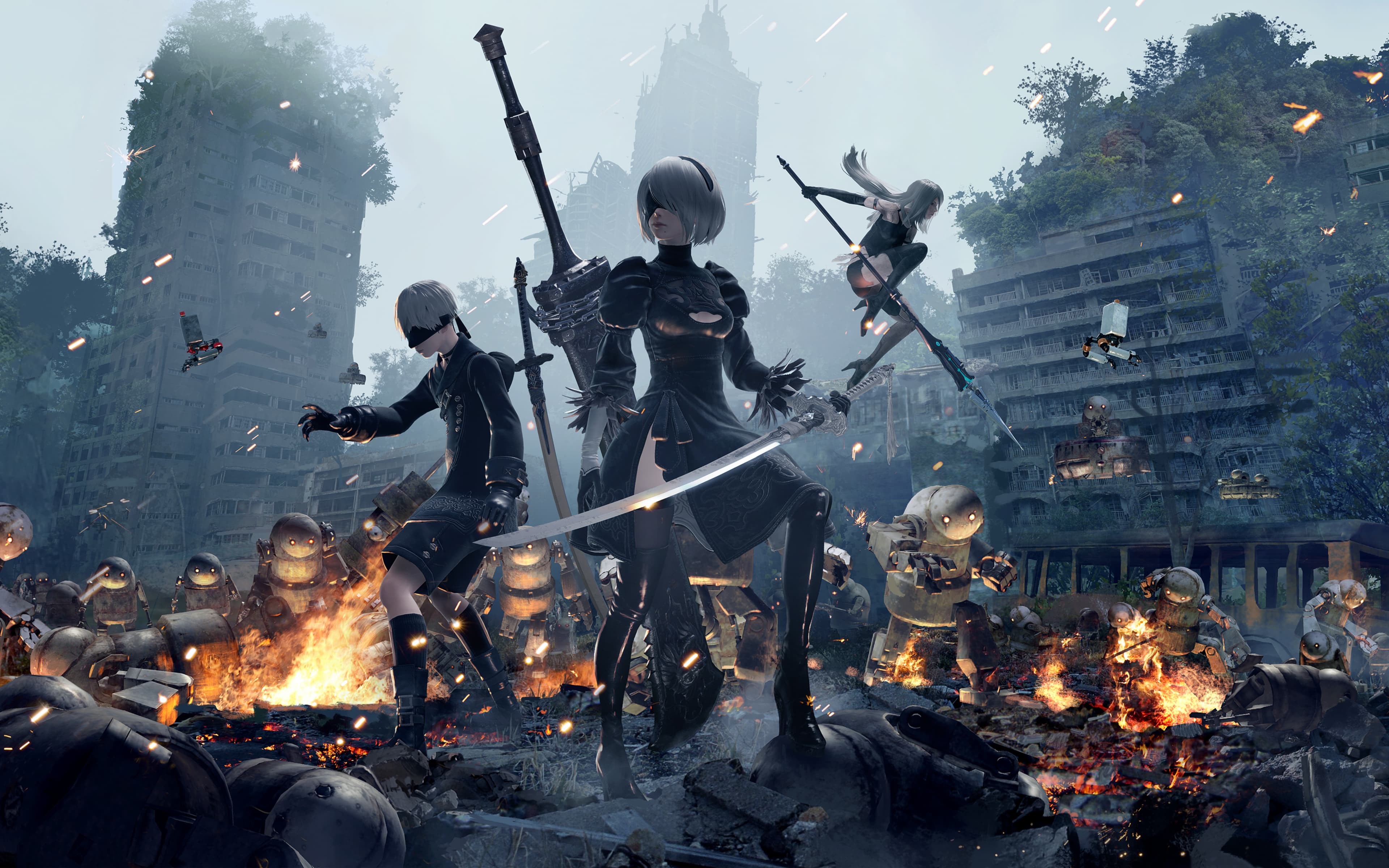
Early on, the player primarily experiences the conflict through 2B's eyes. The basic premise seems straightforward: YoRHa androids are fighting the machines to help humanity reclaim Earth.
Then 9S's perspective begins to reveal information that 2B's story doesn't show.
Later, A2 provides yet another perspective on the same world.
The important part is that these aren't simply repeated versions of the same story.
The same locations, enemies, and events can feel completely different depending on who you are controlling.
Machines that initially seem like nothing more than enemies gradually become harder to categorize.
Some form relationships.
Some try to protect others.
Some imitate human behavior.
The player's understanding of the world changes along with the characters.
What Does It Mean to Kill an Enemy?
In most action games, defeating enemies is simply part of the rules.
You fight because that's what the game asks you to do.
NieR:Automata gradually makes that assumption less comfortable.
The machines initially appear to be simple enemies.
But as the story progresses, you begin to see that they are capable of behavior that looks surprisingly familiar.
They form communities.
They search for purpose.
They imitate things they don't fully understand.
And yet, the player still has to fight them.
That creates one of the game's most interesting tensions.
Mechanically, they are enemies. But the more you learn about them, the harder it becomes to see them as nothing more than targets.
The combat itself begins to carry a different meaning.
Who Decides What Life Is For?
The central theme of NieR:Automata is closely tied to questions about existence and purpose.
The androids fight because they have been ordered to.
The machines act according to their own goals.
But as the story develops, the distinction between following a purpose and choosing one becomes increasingly difficult to define.
Fight because you were ordered to.
Fight because someone depends on you.
Fight to protect someone.
Fight for revenge.
Fight because you don't know what else to do.
These motivations gradually lead back to a much bigger question:
What is the reason for your existence?
That is what GPA's 95% Existential Themes score captures so well.
The game doesn't rely entirely on characters explaining philosophical ideas through dialogue. Instead, it puts those questions into the player's hands through combat, exploration, relationships, and repeated actions.
Building Your Own Combat Setup
The Plug-in Chip system adds another layer to the gameplay.
Players can equip chips that modify abilities such as attack power, defense, and other useful functions. The available capacity also has to be managed, meaning you cannot simply equip everything at once.
This gives players room to tailor their setup.
You can focus on offensive power, defensive abilities, recovery, or utility depending on how you want to play.
It isn't an extremely complicated character-building system, but it gives the action enough flexibility to support different playstyles.
A Beautiful World Built Around Decay
The world of NieR:Automata is another major part of its identity.
Ruined cities, deserts, amusement parks, factories, and other locations all have their own atmosphere.
The world has clearly collapsed, yet many of its environments are strangely beautiful.
That contrast between beauty and emptiness is one of the game's strongest visual qualities.
Music plays an equally important role.
Exploration themes, battle music, and vocal tracks constantly change the mood of a location. The same environment can feel peaceful, lonely, threatening, or tragic depending on what is happening.
GPA's 70% Dystopian Setting, 70% Graphics, and 85% Emotional Story scores reflect how much the atmosphere contributes to the overall experience.