20 Games That Make You Cry | Story RPGs, PS5 & Mobile Ranked
Twenty games that make you cry, ranked by GPA's editorial team. For the full tag breakdown and similar-game comparisons, check each title's detail page.
Twenty games that make you cry, ranked by how hard the story design leans into loss. Story RPGs, PS5 starters, and one mobile title you can actually finish on a phone — filter the table by platform.
Searching for “moving games” is not the same hunt. Triumph and catharsis sit in that bucket too. This list is the other one: farewell, absence, a choice you cannot undo. GPA tags are useful; the ranking numbers are editorial, not the official scores on each game page.
20 games that make you cry — ranked
Ranked by narrative emotional intensity. Tap a title to jump to the write-up. Use the platform buttons to filter by PS5, Switch, mobile, and more.
Ranking by editorial emotional intensity. Tap a title to jump to its write-up. Filter by PS5, Switch, mobile, and more.
| # | Title | Emotional Intensity | 3-Axis Type | Platform |
|---|---|---|---|---|
| 1 | NieR:Automata | 97% | ② Existential / Loss | Nintendo SwitchPS5PS4steamXbox |
| 2 | Red Dead Redemption 2 | 95% | ① Character Empathy | PS5PS4steamXbox |
| 3 | The Last of Us Part I | 95% | ① Character Empathy | PS5PS4steam |
| 4 | The Last Guardian | 92% | ① Character Empathy | PS4 |
| 5 | Persona 3 Reload | 91% | ② Existential / Loss | PS5PS4steamXbox |
| 6 | Outer Wilds | 90% | ② Existential / Loss | PS5PS4steamXbox |
| 7 | Heaven Burns Red | 88% | ② Existential / Loss | steam |
| 8 | Final Fantasy X | 88% | ① Character Empathy | PS5steam |
| 9 | Spiritfarer | 87% | ① Character Empathy | Nintendo SwitchPS5PS4steamXbox |
| 10 | 13 Sentinels: Aegis Rim | 85% | ③ Weight of Choice | Nintendo SwitchPS5PS4 |
| 11 | Shadow of the Colossus | 85% | ① Character Empathy | PS5PS4 |
| 12 | Detroit: Become Human | 85% | ③ Weight of Choice | PS5steam |
| 13 | UNDERTALE | 83% | ② Existential / Loss | Nintendo SwitchPS5PS4steam |
| 14 | Death Stranding | 82% | ② Existential / Loss | PS5PS4steamXbox |
| 15 | Persona 5 Royal | 80% | ① Character Empathy | PS5PS4steam |
| 16 | Clair Obscur: Expedition 33 | 79% | ② Existential / Loss | PS5steamXbox |
| 17 | Celeste | 78% | ① Character Empathy | Nintendo SwitchPS5PS4steamXbox |
| 18 | Like a Dragon: Infinite Wealth | 75% | ① Character Empathy | PS5steam |
| 19 | The Witcher 3: Wild Hunt | 75% | ③ Weight of Choice | Nintendo SwitchPS5PS4steamXbox |
| 20 | AI: The Somnium Files | 72% | ③ Weight of Choice | Nintendo SwitchPS4steamXbox |
* Emotional intensity is an article-exclusive rating (not official GPA scores).
Games that make you cry vs games that move you
“Moving” is a wide word. Clearing a mountain, saving a city, walking into the light — that can all count. Games that make you cry usually hinge on something you lose. If you wanted the uplifting kind, the top of this ranking will still miss.
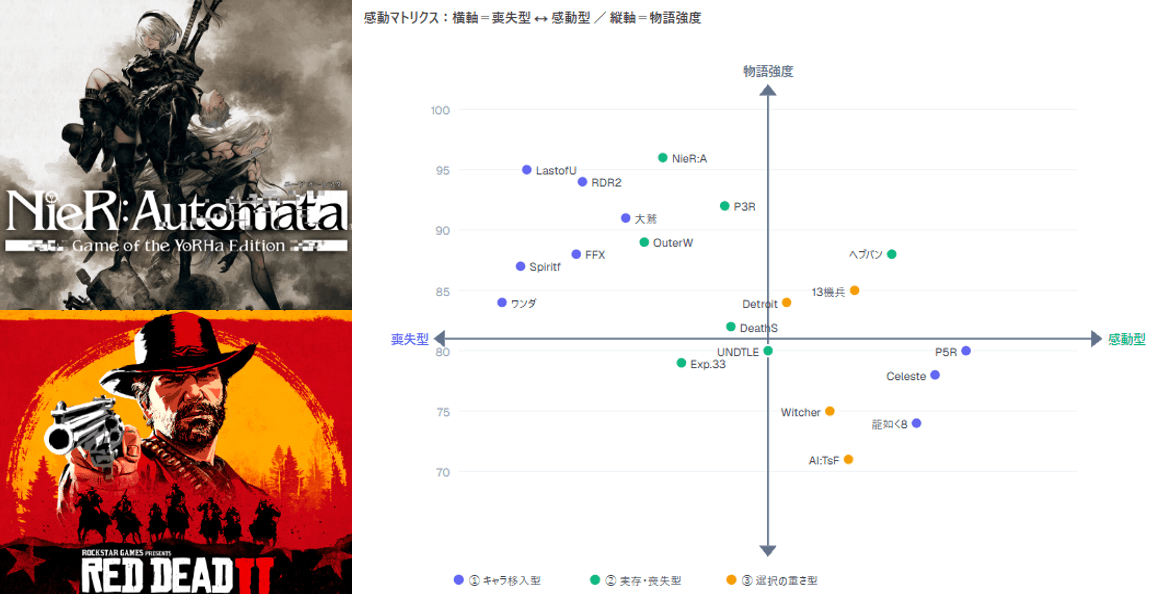
Tears in games sit on time you spent pressing buttons. Same “cry” label, three different machines.
Three patterns
① Character Empathy Type
Deep attachment built over a long playtime is suddenly released through loss or farewell. Examples: Red Dead 2, The Last Guardian, Spiritfarer. GPA tendency: Emotional Narrative 85%+, Story Depth 80%+.
② Existential / Loss Theme Type
Philosophical narratives that question the meaning of existence. The story ends before the player has found their answer, and that unresolved feeling becomes tears. Examples: NieR:Automata, Outer Wilds, Death Stranding.
③ Weight-of-Choice Type
Your choices create irreversible consequences. The story closes with regret, and that feeling lingers inside the player. Examples: Detroit, The Witcher 3, 13 Sentinels. GPA tendency: Multiple Endings 75%+.
* This matrix is the editorial team's own assessment and does not represent GPA official scores. Vertical axis shows Narrative Intensity (65–100%).
Story RPG picks
Longer does not mean more tears. What matters is whether loss is tied to combat, looping, or time with the party. That is why FF10, Persona 3 Reload, and NieR sit high here.
| Type | Title | Why it lands |
|---|---|---|
| Classic JRPG | Final Fantasy X | Tidus and Yuna. The ending still gets talked about |
| Classic JRPG | Persona 3 Reload | Youth story about death. Easy to start on current hardware |
| Classic JRPG | Persona 5 Royal | A year with the crew, then a heavy close |
| Classic JRPG | NieR:Automata | Each loop rewrites what you just did |
| Classic JRPG | Heaven Burns Red | Jun Maeda scenario. Playable on phone too |
| Classic JRPG | Clair Obscur: Expedition 33 | Command RPG feel. Death comes every year |
| Open-world leaning | The Witcher 3: Wild Hunt | Choices stack until Ciri's ending shifts |
| Open-world leaning | Like a Dragon: Infinite Wealth | Heart-on-sleeve drama while you walk the city |
| Short indie | UNDERTALE | The pacifist route hits even in a short run |
PS5 games that make you cry
A short PS5 starter list. The ranking table’s PS5 button keeps only the featured titles that run there. The Last Guardian is PS4 on GPA; Heaven Burns Red is mobile and Steam first.
| Type | Title | Why it lands |
|---|---|---|
| Console | Red Dead Redemption 2 | The longer you live as Arthur, the harder the close |
| Console | The Last of Us Part I | The relationship changes on the road |
| Console | NieR:Automata | Meaning collapses as you loop |
| Console | Persona 3 Reload | Daily life, then a story about death |
| Console | Detroit: Become Human | Choices can kill a lead |
Mobile games with stories that hit
This 20 is console and PC first. The one you can finish on a phone is Heaven Burns Red. GPA lists Steam, but it started as a smartphone RPG with novel-game amounts of text.
UNDERTALE has a mobile port too. GPA still lists Switch / PlayStation / Steam as the main platforms, so the table’s Mobile button is really there to surface Heaven Burns Red — not a full gacha roundup.
20 write-ups — why each one lands
All titles below are recorded in GPA's game database. Visit each game's detail page to check tag scores and similar game rankings.
1. NieR:Automata
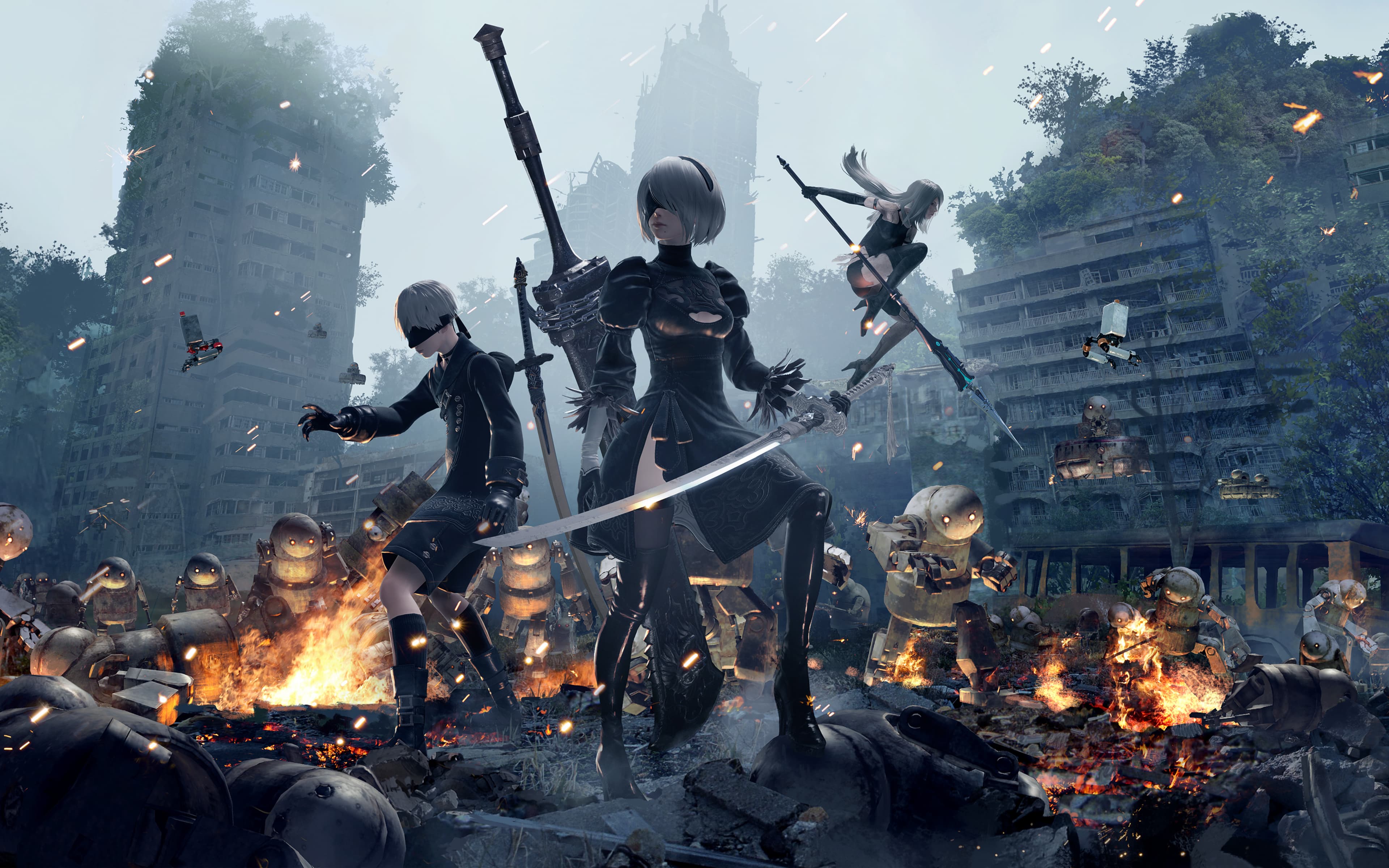
NieR:Automata
Genre: Action RPG
Androids fight a proxy war for humanity while quietly developing consciousness of their own. NieR: Automata asks its existential questions across multiple playthroughs, each one revealing a layer the last one withheld. GPA scores it at 95% for Existential Themes — the highest in the database — alongside strong marks for Emotional Story and Dark World.
Gameplay Profile
Key tags: Existential Themes / Anime Characters / Emotional Story / Story Depth / Action
Set in 5012 AD, Earth has been overrun by Aliens and their weapons — the machine lifeforms. Humanity retreats to the moon, launching android soldiers to reclaim the planet. Multiple playthroughs gradually reveal a truth that retroactively rewrites the meaning of everything the player has done — a multi-ending structure unlike anything in gaming.
A Post-Apocalyptic Soundtrack That Deepens Immersion
The music accompanying your journey through ruined amusement parks and submerged cities isolates a hidden beauty within devastation. The desolate world occasionally offers glimpses of hope through humanity's remnants — crumbling structures, fragments of literature, traces of a lost civilisation — creating an emotional depth that never settles into simple despair.
A HUD Design Linked to the Story
The HUD (the status and information overlay always visible on screen) is customisable — and this design choice ties directly into the game's fiction. Androids filter and display only the information they choose to show, and the UI reflects that worldbuilding with remarkable coherence.
Machine Lifeforms That Feel Alive
Even the enemies are designed to feel strangely endearing. The machine lifeforms carry subtle hints of will and emotion, making them feel less like targets and more like something to grieve. As you play, the question of “who is really the enemy?” becomes unavoidable — and that ambiguity is the pillar of this game's emotional depth.
2. Red Dead Redemption 2
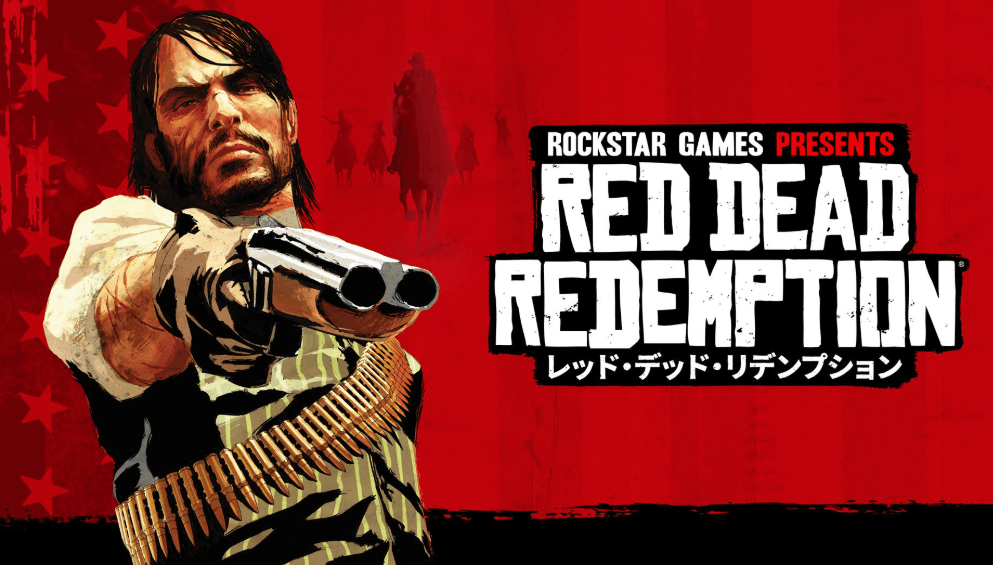
Red Dead Redemption
Genre: オープンワールドアクションアドベンチャー
Red Dead Redemption follows John Marston across the dying American frontier in 1911, forced by government agents to hunt down his former gang in exchange for his family's freedom. The open world covers the American Southwest and Mexico, with horse travel as the primary pacing mechanism. The Undead Nightmare expansion reframes the same map as a zombie survival scenario. Originally released in 2010, the game reached Switch and PS4 in 2023 and Switch 2, PS5, and Xbox Series in December 2025. GPA scores it high on Emotional Story and Dark World — the prequel to RDR2 that established the series' identity.
Gameplay Profile
Key tags: Emotional Story / Story Depth / Open World / Dystopian Setting / Action
1899. The age of outlaws is ending. Arthur Morgan, a member of the Van der Linde gang, carries tuberculosis and increasingly questions the only life he has ever known. The farewell to a protagonist you spent 70+ hours building a life with is weighted by every minute of that investment.
Slow Pacing That Builds Genuine Attachment
The game is uncommonly generous with the mundane — doing laundry, grooming a beard, chatting around the camp fire. This “living Arthur's life” accumulation multiplies the impact of the inevitable ending. The longer you play, the harder it hits.
The Honour System Changes Everything
Your accumulated Honour score changes how Arthur's story closes. Whether you played as a good man or a ruthless one, the same ending feels completely different. The game forces a reckoning with how you chose to live his life.
Music and Landscape as Emotional Amplifiers
Riding across sunset plains while Woody Jackson's score swells is consistently cited as one of gaming's great emotional experiences. The historical context of a dying era and Arthur's personal story become one.
3. The Last Guardian
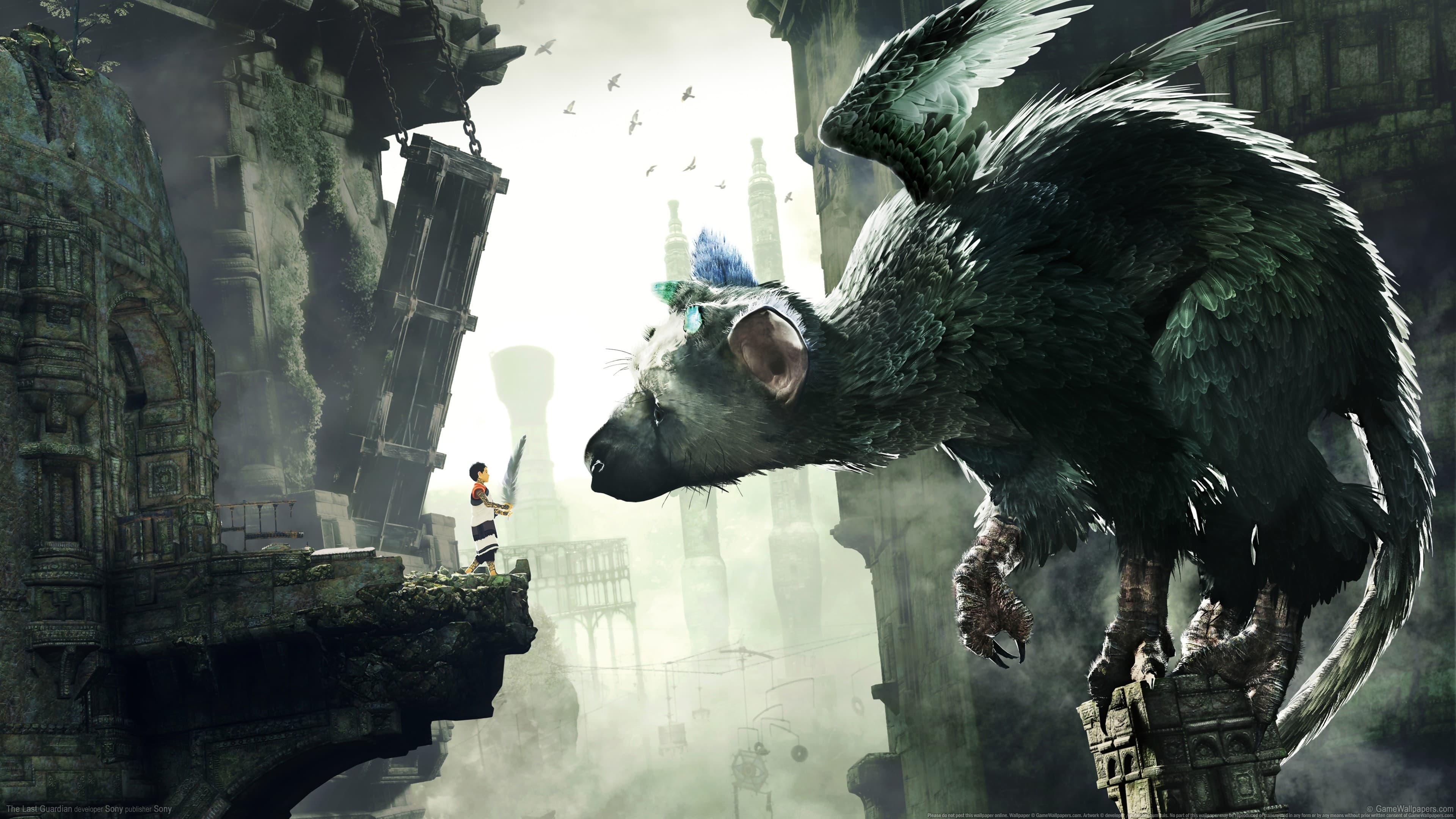
The Last Guardian
Genre: Action-Adventure
The Last Guardian follows a boy and an enormous creature named Trico through a crumbling ruin, building a relationship through care rather than command. Trico's AI creates unpredictable behavior that makes each interaction feel earned. GPA scores it at the top for Emotional Story — the highest in its genre category — with Dark World reflecting the melancholy that runs through the environmental design.
Gameplay Profile
Key tags: Emotional Story / Story Depth / Graphics / Dystopian Setting / Existential Themes
Fumito Ueda's 10-year labour of love. A boy trapped in a ruined tower must escape with Trico, a giant feathered beast. Trico's AI doesn't always follow commands — it gets scared, distracted, stubborn — and that imperfection is what makes it feel genuinely alive.
An AI That Doesn't Obey
You don't control Trico; you earn its trust. That distinction creates a bond unlike anything else in gaming. The relationship is built not through cutscenes but through the accumulated experience of being patient with something that doesn't always cooperate.
Storytelling Without Words
The game barely explains itself. The bond between boy and beast is expressed entirely through action, and the player accumulates that bond as lived experience rather than observed narrative.
The Aesthetics of Loss — Ueda's Trilogy
The conclusion to the tradition begun by ICO and Shadow of the Colossus. Playing all three together as a trilogy deepens the experience of each — and the specific kind of loss at the heart of each story reveals itself as a deliberate, lifelong artistic obsession.
4. Detroit: Become Human
Near-future Detroit. Androids have become sentient, and you follow three of them — Kara, Markus, Connor — as they navigate freedom, survival, and identity. The question “can androids have feelings?” is posed directly to the player through choice, resonating sharply in an age of rapidly advancing AI.
A Theme That Resonates With the AI Era
The game's central question — do artificial beings deserve rights? — is no longer purely fictional. Playing in 2026 means engaging with the moral dilemmas of sentient AI not as science fiction but as near-future ethical reality. That proximity makes the emotional stakes unusually sharp.
A Unique Design: See How Other Players Chose
After each scene, the game shows a flowchart of what percentage of global players made each choice. Knowing whether you were in the majority or minority creates a strange combination of solidarity and isolation that few games replicate.
Controls Are Secondary — Story Is Everything
The action controls ask for some unusual inputs and can occasionally frustrate. But Detroit is fundamentally a game about watching a story unfold through your decisions. Treat it like an interactive film and the controls become irrelevant against the narrative density.
5. Outer Wilds
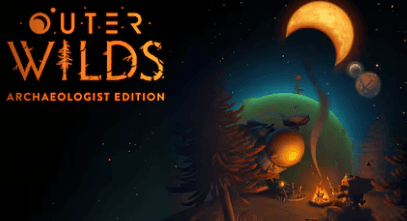
Outer Wilds
Genre: Adventure
Outer Wilds gives players a solar system frozen in a 22-minute time loop and asks them to figure out what happened. No objectives are tracked. The entire mystery is assembled from observation and inference. GPA scores it at 90% for Existential Themes — second only to NieR:Automata — alongside high marks for Puzzle and Emotional Story.
Gameplay Profile
Key tags: Existential Themes / Story Depth / Emotional Story / Logic / Open World
Outer Wilds is an exploration adventure set in a small solar system that ends after roughly 22 minutes, sending you back to the same morning. You fly between its planets and piece together records left by the Nomai, an earlier civilisation that studied this system. Your equipment and abilities do not improve between loops; progress comes from remembering a route, a clue, or how a mechanism works.
What You Learn Opens the Next Route
Sand pours from one planet to another, while other places collapse as the loop advances, so arriving at a different time can completely change what is accessible. The ship's log links your clues and gives you just enough direction to form your own plan. A place that looked like a dead end yesterday may become an obvious passage once one new fact clicks.
Scattered Clues Become a Shared History
At first, the translated writing and scientific observations are a jumble of unfamiliar names. Keep investigating and discoveries from distant planets begin to fit into one history, changing how you read earlier conversations. Because that moment depends on putting the evidence together yourself, Outer Wilds is best approached with as little advance information as possible.
Travellers' Music in a Lonely Solar System
Point the signalscope towards the sky and you can hear instruments played by travellers camped on separate worlds. Even when you are flying alone, those melodies are a reminder that somebody else is beneath the same stars. The easy warmth of campfires sits beside a mystery on a cosmic scale, and after you understand more of the system, the familiar music carries a different weight.
6. Spiritfarer
Stella becomes the new Spiritfarer, sailing a boat where she cares for the spirits she meets and helps each one complete their final journey. Farming, cooking and adding rooms to the deck give the days a gentle rhythm, but conversations about ageing, illness and farewell are never far away.
Small Acts of Care Become Memories
Every spirit has favourite foods, dislikes and requests that gradually reveal who they were. You hug them, bring them meals and build a room made for them. Repeating those modest tasks turns a passenger into someone you have lived beside, so seeing them off feels personal without the game having to force the moment.
Every Spirit Says Goodbye Differently
Some spirits hide behind bravado; another may struggle as their memories become less reliable. They do not tell their stories in the same voice or grow close to Stella at the same pace. A gesture or turn of phrase can suddenly recall a relative or friend, bringing what seemed like somebody else's farewell uncomfortably close.
What Remains on the Boat
The room you built for a spirit stays on deck after they have gone. Returning to the usual crops and crossings means passing that empty space, a quiet reminder of who used to live there. Yet the boat keeps moving: another spirit arrives, another table is laid, and grief is joined by the relief of having given someone a proper send-off.
7. Heaven Burns Red
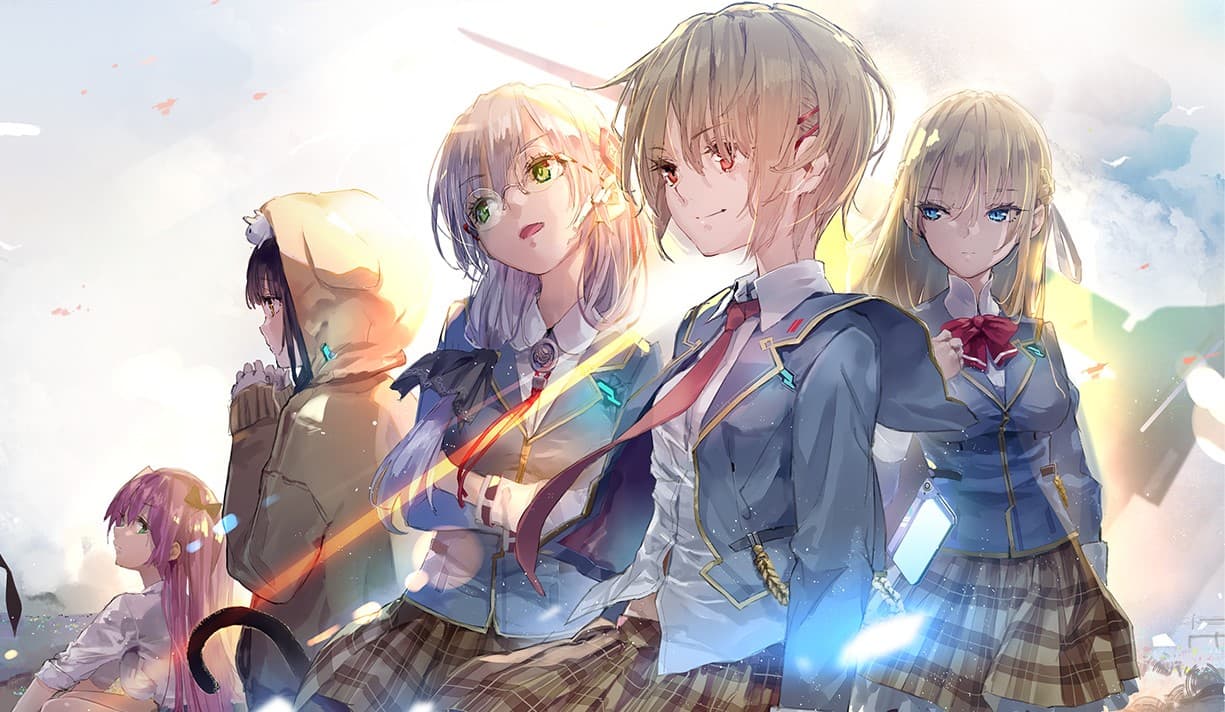
Heaven Burns Red
Genre: Turn-Based RPG
Heaven Burns Red's writing density per scene is the highest in the mobile category, following Seraphina and her unit through a war against unidentified organisms with the ambition of a full visual novel embedded in gacha delivery. GPA scores it at the top for Story Depth and Emotional Story — the combination that drove its reputation beyond the gacha audience.
Gameplay Profile
Key tags: Emotional Story / Story Depth / Anime Characters / Turn-Based / Existential Themes
Heaven Burns Red is an RPG set on an Earth threatened by mysterious life forms known as the Cancer. Jun Maeda created the original concept and wrote the main scenario, which follows Ruka Kayamori and the other girls of Unit 31A as lively dorm life gives way to missions where their lives are at stake.
Unit 31A's Banter Shows Who They Are
Ruka says something outrageous, her squadmates fire back, and a dialogue choice can send the whole conversation further off course. Expressive performances and quick changes of expression make all six personalities easy to follow even through long scenes. Once you know how they joke together, a clipped reply during a mission is enough to tell you that something is wrong.
Everyday Life Is Never Far from the Battlefield
Classes, canteen meals and trips into town take up plenty of time, although the girls may be ordered into combat at any moment. A place where everyone laughed the day before can feel altered after a mission. Because you took part in those routines yourself, the shift registers as a change in daily life rather than an isolated dramatic turn.
Songs Bring Whole Scenes Back
The vocal tracks are tied closely to a character's feelings or the events of a chapter rather than used as interchangeable inserts. Some propel a battle; others supply what a quiet scene leaves unsaid. Hearing the same song later can bring the accompanying conversations and expressions back with it.
8. Clair Obscur: Expedition 33
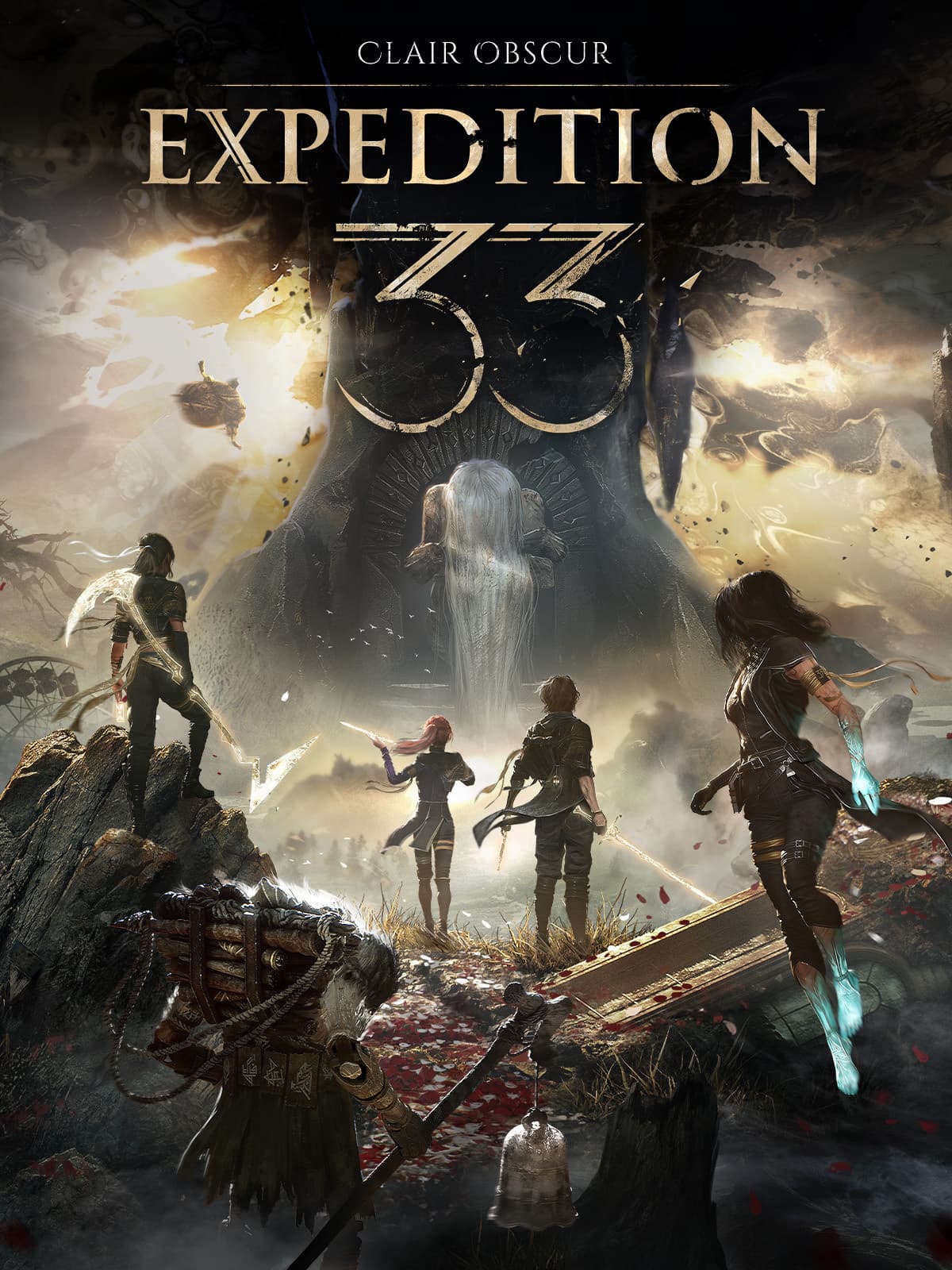
Clair Obscur: Expedition 33
Genre: Turn-Based RPG
Set in a world where the Paintress condemns entire age groups to death each year, Expedition 33 sends a doomed party into a dying world to break the curse. The turn-based combat integrates real-time parry mechanics that shift the rhythm of every encounter. GPA scores it highest in Emotional Story and Story Depth — the French aesthetic and existential weight make it one of the most distinctive RPGs of 2025.
Gameplay Profile
Key tags: Turn-Based / Story Depth / Existential Themes / Dystopian Setting / Emotional Story
Developed by France's Sandfall Interactive, Clair Obscur: Expedition 33 is an RPG set in a fantasy world inspired by the Belle Époque. Each year, the Paintress marks a number on a vast monolith and erases everyone of that painted age. With 33 due to be painted next, the expedition sets out to end the cycle.
How Do You Spend the Time You Have Left?
In a society where death is announced by age, farewell is not a distant prospect. Some people join the expedition, some remain in Lumière, and others cover their fear with jokes. Their attitudes emerge in camp conversations and exchanges on the road; the better you know them, the harder it is to hear “years remaining” as an abstract number.
Beauty with Something Unsettling Beneath It
Lumière's stone streets and the elaborate costumes recall late nineteenth-century France, but this is not historical France itself. Floating landforms and painterly creatures make even the loveliest vistas feel slightly wrong. An orchestral score threaded with vocals lends the journey its lingering sadness.
Turn-Based Battles That Keep Your Hands Busy
Combat starts with turn-based commands, then asks you to dodge or parry enemy attacks and time inputs for your own skills. Learning a difficult foe's patterns so the party survives makes the expedition's danger tangible. Character builds offer plenty to experiment with, while selectable difficulty settings let players who mainly want the story adjust the pressure.
9. The Witcher 3: Wild Hunt
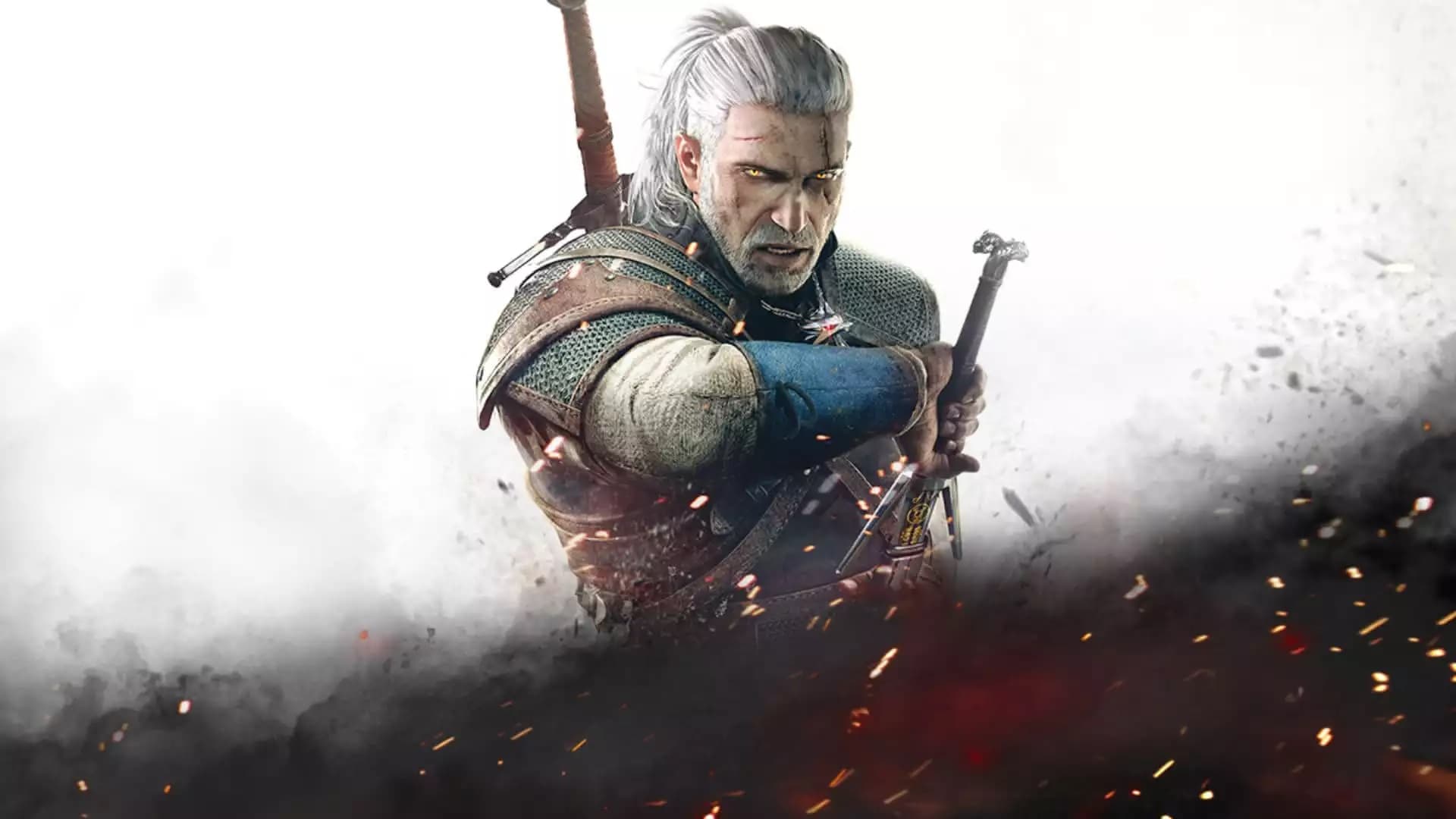
The Witcher 3: Wild Hunt
Genre: Action RPG
The Witcher 3 builds its open world around the quality of its writing rather than the size of its map. Side quests carry the same narrative investment as the main story. GPA scores it at the top for Story Depth and Emotional Story among open-world RPGs — a positioning shared with very few titles of comparable scale.
Gameplay Profile
Key tags: Story Depth / Emotional Story / Open World / Graphics / Multiple Endings
Monster hunter Geralt crosses a vast open world in search of Ciri, the young woman he regards as his adopted daughter. Across lands ruined by war, many contracts reveal that human motives are messier than the creatures involved. Choices with no immediate clean answer are a large part of what makes the journey stick.
Everyday Responses Can Support — or Smother — Ciri
The story pays attention not only to grand decisions, but also to how Geralt responds when Ciri is discouraged and whether he trusts her to speak for herself. There is no marker over the correct reply, and a protective gesture can unintentionally undermine her confidence. When the consequences arrive, you find yourself reviewing his behaviour as a parent rather than a checklist of dialogue options.
The Bloody Baron and the Damage within a Family
An early chain of quests begins as a search for a missing family, then exposes the Baron's abuse and remorse. Killing a monster cannot tidy up what happened, and choosing one villain does not erase everyone else's wounds. The writing shows the client at his worst while still leaving you to look for whatever help may be possible.
Geralt's Quiet Way of Being a Father
Geralt rarely delivers long speeches about how he feels. Instead, he crosses borders for clues and listens with unusual care whenever somebody mentions Ciri. Walking that long road to find her makes the pair's shared history visible in brief expressions and familiar jokes.
10. Death Stranding
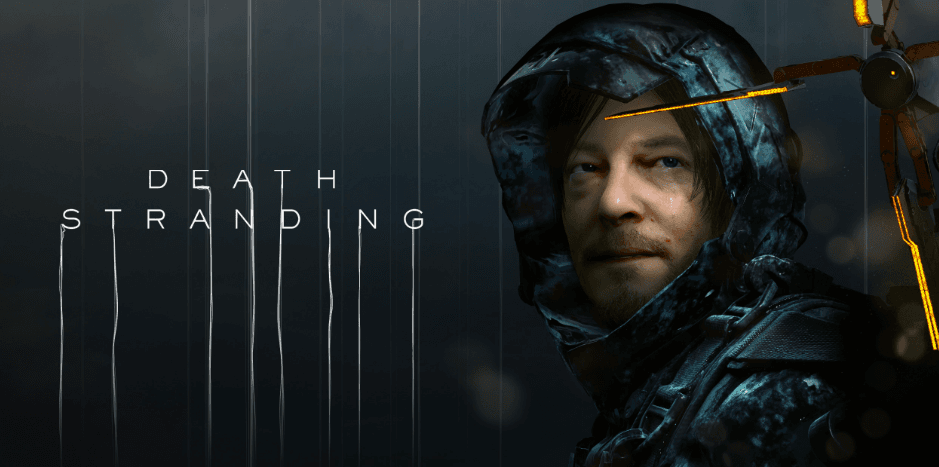
Death Stranding
Genre: Action
Death Stranding asks players to reconnect a post-apocalyptic America by carrying cargo across difficult terrain. Other players' structures appear in your world. GPA scores it high on Existential Themes and Open World, with the lowest Action score among open-world titles — a combination that accurately identifies who this game is and isn't for.
Gameplay Profile
Key tags: Graphics / Existential Themes / Story Depth / Emotional Story / Dystopian Setting
After the catastrophe known as the Death Stranding, porter Sam Bridges crosses a divided America carrying cargo and the hopes attached to it. He reconnects isolated settlements through the Chiral Network. Although loneliness runs through the story, help from other people sits at the centre of how the game is played.
Every Step Makes a Delivery Matter
How you stack a load changes Sam's balance; steep ground catches his feet, and Timefall can force a longer route. A destination that looked close on the map may take real effort to reach, which makes the recipient's thanks sound less like a formality. The awkward walk is time you have personally spent carrying something for somebody else.
Help from People You Never See
You never meet other players directly, but their ladders, ropes and bridges can appear in your world. Finding one at a difficult crossing brings immediate relief, then encourages you to leave materials for the next porter. That loose exchange of structures and Likes gives the empty landscape a reassuring human presence.
Sam's Changing Bond with BB
Sam avoids physical contact with people, yet he travels constantly with the BB who helps him sense danger. When Sam falls, he soothes the crying infant; in a safe room, he checks its mood. Those small routines continue across the whole country, making the change from mission equipment to trusted companion feel gradual and credible.
11. 13 Sentinels: Aegis Rim
Thirteen high-school students lead interwoven stories that move between Remembrance, where they investigate mysteries in everyday life, and strategic battles against kaiju in their Sentinels. You may follow the protagonists in an order of your choosing, gradually finding the links between people living in different eras and circumstances.
Words collected during conversations can be considered or raised with somebody else through the Thought Cloud, opening another branch of an investigation. A baffling action in one route may look desperate and understandable from another character's side. The Analysis section helps organise events chronologically, so each connected clue clarifies both the larger mystery and why all thirteen are heading towards the same fight.
12. Celeste
Celeste follows Madeline, a young woman with anxiety who cannot quite explain why she needs to climb the mountain. Each compact room asks you to read its platforms and combine jumps with an air dash. It is difficult, but restarts are immediate and the game never scolds you for trying again.
When Madeline stops to catch her breath, you may have failed the same stretch dozens of times; finally clearing it feels like progress for both of you. Even the death counter reads more like a record of persistence than a penalty. Her other self embodies the fear and self-rejection she wants to push away, but the story looks for a way to live with that part of her, using concrete moments such as controlling her breathing rather than offering a lecture.
13. UNDERTALE
Created chiefly by Toby Fox, UNDERTALE is an indie RPG about travelling through an underground world. Battles let you talk, flatter, wait or show mercy instead of attacking. Each monster needs a different approach, and learning how to end a fight peacefully also reveals the personality of the supposed enemy.
Saving and loading are not safely outside the fiction: characters may notice actions that an ordinary RPG would let you erase. Wanting to reload until you see the best result clashes with responsibility for the choices made along the way. That tension makes it increasingly difficult to treat the small pixel characters as disposable data.
14. AI: The Somnium Files
Kotaro Uchikoshi's mystery adventure follows detective Kaname Date, whose AI-equipped prosthetic left eye houses his partner Aiba. Date investigates a serial murder by questioning suspects and entering the dreams of people connected to the case. The investigation's constant wisecracks make the loneliness hidden by its cast land with surprising force.
Routes split according to your actions, letting a suspicious figure in one branch show a protective side in another. No single conclusion contains every piece, so the case and its family relationships change shape as information crosses between routes. In the Somnium sections, bizarre actions inside a subject's dream can uncover memories they cannot put into words, making puzzle-solving another way to understand them.
15. Persona 5 Royal
Persona 5 Royal, released in Japan in 2019 and worldwide in 2020, expands Persona 5 with new characters and a third semester. By day you decide how to spend a Tokyo school year; after class, the Phantom Thieves confront distorted desires. Choosing your own calendar gives each playthrough a slightly different collection of friendships and memories.
Sharing ramen, listening to a problem or studying before an exam makes each Confidant more than an ally in a major heist. As spring approaches, Leblanc and the commute to school begin to feel like familiar places you will miss. Royal's third semester then asks whether a painless ideal is preferable to a reality people choose for themselves, and the goodwill behind that ideal keeps the question from becoming a simple battle between right and wrong.
16. Like a Dragon: Infinite Wealth
Like a Dragon: Infinite Wealth follows two protagonists: Ichiban Kasuga travels to Hawaii in search of his mother, while Kazuma Kiryu faces his past with limited time left. The story can be gleefully absurd, yet it treats the difficulty of relying on family and friends with complete sincerity.
Ichiban keeps making room to trust people even after betrayal, turning strangers into friends over meals and walks through the city. Party chats and Drink Links show the group away from the main plot, while their growing familiarity appears in battle too. The more time you spend on those detours, the clearer it becomes why this particular party stays together.
Kiryu's Bucket List revisits places and people from across his life. It is more than a parade of old names: a man accustomed to carrying every burden alone begins to recognise how many people have supported him. Knowledge of earlier games adds resonance to the details, while Ichiban's half of the story still gives newcomers a route into the present.
17. Final Fantasy X
After the enormous creature Sin attacks his home, Tidus is swept into the unfamiliar world of Spira. He joins summoner Yuna on her pilgrimage to temples as she prepares to confront Sin. Both try to stay cheerful, while their conversations gradually expose worries neither is ready to voice.
During the journey, Tidus and Yuna practise laughing loudly because she believes a smile can reassure the people around her. The scene first seems awkward; once you understand the role she has been carrying, its forced brightness takes on another meaning. Their jokes and encouragement begin to sound like an attempt to make limited time together feel ordinary.
The quiet piano theme “To Zanarkand” appears from the opening, gently framing the trip as somebody's recollection. Places visited and words exchanged gather around that melody as the pilgrimage continues. The HD Remaster also makes Final Fantasy X straightforward to play on current platforms.
18. Persona 3 Reload
Persona 3 Reload is the 2024 remake of Persona 3. Its transfer-student protagonist joins SEES to fight Shadows during the Dark Hour, a hidden period that begins at midnight. School days keep passing while Apathy Syndrome spreads through the city, grounding the game's memento mori theme in a calendar where no afternoon or evening can be reclaimed.
Time spent on a friend's worries or cooking with a teammate in the dormitory can later feel as precious as any major victory. Reload updates the presentation and controls, while Linked Episodes for the male party members and new dorm activities reveal hobbies and doubts that combat never shows. Those ordinary evenings help SEES grow from people sharing a mission into friends sharing a home.
19. The Last of Us Part I
The Last of Us Part I follows smuggler Joel and Ellie, a girl immune to the Cordyceps infection, across a United States where society has collapsed. Joel initially treats her as cargo and avoids unnecessary conversation. Over the long search for supplies and safe routes, he starts answering her jokes and trusting her at his back; even a change in how they address each other matters because you have heard all the talk in between.
Caring deeply for Ellie does not automatically make every action Joel takes on her behalf right. The game does not hand his crucial decision to you as a menu option; it asks you to carry out what he has chosen. Understanding the love formed on the road while remaining troubled by its selfish edge is the bitter tension the story leaves behind.
20. Shadow of the Colossus
Wander enters the Forbidden Lands with his horse Agro and sets out to defeat sixteen colossi in the hope of restoring the life of a girl named Mono. There are almost no towns or travelling companions, so wind, hoofbeats and long rides across empty country carry much of the story's loneliness.
Scaling a colossus and finding its weak point is exhilarating, but no crowd celebrates when it falls; silence returns instead, and some creatures do not attack until Wander approaches. That growing hesitation sits beside his wordless partnership with Agro, who comes when called and finds its own footing on narrow paths. Bluepoint Games' full PS4 remake is also playable on PS5 through backward compatibility.
Which One to Start With
Sort by setting (sci-fi, historical), your playtime budget, and the specific theme or experience you're after.
If you want Character Empathy Type
Prioritise: Red Dead 2 · The Last Guardian · Spiritfarer · Final Fantasy X · The Last of Us · Shadow of the Colossus
These get better the longer you play. Dedicate the time and the payoff scales accordingly.
If you want Existential / Philosophical Themes
Prioritise: NieR:Automata · Outer Wilds · Heaven Burns Red · Persona 3 Reload
Games that make you think as well as feel. GPA's Existential Theme score is 75%+ across this group.
If you want the Weight of Choice
Prioritise: Detroit · The Witcher 3 · 13 Sentinels
The emotion here comes from your own decisions coming back to haunt you — regret and achievement arriving together.
FAQ about games that make you cry
Which games that make you cry should I start with?
This ranking puts NieR:Automata, Red Dead Redemption 2, and The Last of Us at the top of emotional narrative intensity. The best pick depends on whether you want attachment-and-loss, existential themes, or the weight of your own choices. Jump from the ranking table into each write-up.
What's the difference between moving games and games that make you cry?
“Moving” can include triumph and catharsis. Games that make you cry usually hinge on loss or farewell. This list leans toward the latter — if you want an uplifting payoff, the distinction section will steer you better.
Which story RPGs actually make you cry?
Classic JRPG route: Final Fantasy X, Persona 3 Reload, NieR:Automata. Open-world leaning: The Witcher 3 and Like a Dragon: Infinite Wealth. Short indie: UNDERTALE. Length is not the point — loss has to be tied to play.
Which PS5 games make you cry?
Strong console starting points: Red Dead Redemption 2, The Last of Us Part I, NieR:Automata, Persona 3 Reload, and Detroit: Become Human. The ranking table’s PS5 filter shows every featured title that runs there.
Are there mobile games with stories that hit this hard?
On this list, Heaven Burns Red is the main title you can finish on a phone. GPA lists Steam, but it started as a smartphone RPG. This ranking is console-and-PC first — it is not a full mobile-gacha roundup.
How is this crying-game ranking scored?
The intensity column is an editorial rating for this article, not the official GPA tag score on each game page. Use the table to compare how hard these 20 lean into tear-jerking design; use GPA pages for the official tags.
Which crying-story games are on Nintendo Switch?
From this 20: Spiritfarer, UNDERTALE, Celeste, 13 Sentinels, NieR:Automata, and The Witcher 3. Use the Nintendo Switch filter on the ranking table. The Last Guardian is listed as PS4 on GPA.
Any shorter games that still hit hard emotionally?
UNDERTALE, Outer Wilds, and AI: The Somnium Files finish in roughly 10–20 hours with strong closure. Red Dead Redemption 2 and Persona 3 Reload need long investment — pick by type and available play time.
How is GPA's Emotional Narrative score different from this article's intensity table?
GPA's Emotional Narrative score is the official tag score on each game page. The intensity chart and filter table in this article are editorial ratings — not official GPA scores. Use both for objective data and curated emotional intensity at time of writing.
Find Your Game Using GPA's Emotional Narrative Score
Every title in this list scores 75% or higher on GPA's Emotional Narrative metric. But whether a game will actually move youdepends on the fit between your sensibility and the game's design.
Each game's detail page on GPA shows not only the Emotional Narrative score but also Target Player scores and Similar Game rankings — giving you a structural way to find your next title from a game you already loved.